

Part time cfo services are a strategic, cost-effective way for CEOs, founders, and small business owners to gain senior financial leadership without the overhead of a full-time executive. These engagements—often labeled fractional CFO, virtual CFO, outsourced CFO, or interim CFO—deliver high-level financial planning, cash flow management, forecasting, KPI reporting, and capital strategy tailored to the company's stage and immediate priorities.
Below is a practical, authoritative guide that explains what these services are, the problems they solve, how they operate in practice, and how to evaluate and onboard a part time CFO so the relationship produces measurable business outcomes.
Start by understanding the core role and models for outsourced financial leadership so expectations align with outcomes.
What part time cfo services really mean: models, scope, and how they differ from a full-time CFO
Defining the models: fractional, virtual, outsourced, interim
A fractional CFO provides a defined number of hours or days per month focused on strategy and oversight. A virtual CFO relies on cloud tools and remote work to deliver continuous reporting and advisory services. An outsourced CFO may be provided by a firm that combines people and systems (controllers, FP&A analysts, financial ops) under a single engagement. An interim CFO fills a temporary gap—during transitions, M&A, or founder leave—with full-time intensity for a defined period.
The differences are primarily in intensity, continuity, and breadth: fractional and virtual CFOs are suited for ongoing advisory needs at a lower cost, outsourced offerings can include back-office execution, and interim CFOs are tactical and full-time for defined terms.
Typical scope of work and deliverables
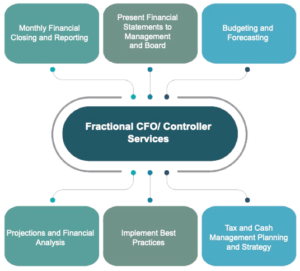
Part time CFOs commonly deliver:
- Monthly or weekly reporting and KPI reporting decks aligned to board or investor expectations.
- Rolling forecasts, including a 13-week cash flow forecast, burn rate and runway analysis.
- Budget vs actual analysis and variance analysis to surface operational gaps.
- Cash optimization and working capital guidance to improve liquidity.
- Capital strategy for fundraising, debt, or debt/equity trade-offs.
- Implementation of basic FP&A processes and dashboards, and strengthening of internal controls.
How part time CFOs differ from controllers and accountants
A controller/finance manager focuses on accurate books, closing the period, accounts payable and receivable, and compliance. A part time CFO prioritizes forward-looking strategy: interpreting financials to influence strategy, advising on capital structure, stress-testing scenarios, and communicating financial story to investors and lenders. Many part time CFOs work with existing accounting staff, upgrading controls and the financial reporting framework while leaving transactional work to the controller.
Now that the definitions and scope are clear, consider the business problems these services are designed to solve—this is where value becomes measurable and persuasive.
Problems and pains solved by part time cfo services: what keeps founders awake at night
Poor cash visibility and unpredictable liquidity
Uncertain cash flow is the single most common and acute issue. Without a reliable 13-week cash flow forecast, companies mis-time payroll, vendor payments, and capital investments. Part time CFOs install a discipline of weekly cash forecasting, scenario planning for burn rate and runway, and working capital interventions—short-term lines of credit, payment-term negotiation, and inventory turn improvements—to avoid liquidity shocks.
Slow, unreliable financial reporting and decision lag
Late books and inconsistent KPI reporting create a lag between operations and decision-making. CEOs make product, hiring, or pricing decisions on stale or incomplete information. Part time CFOs establish cadence—monthly close timelines, recurring KPI packs, and live dashboards—so leadership has timely, reliable inputs.
Lack of investor-ready financials and story
Preparing for fundraising requires clean historicals, defensible metrics, and a credible forecast. Investors assess growth drivers, margin expansion, and capital needs. A part time CFO guides preparation of investor decks, sensitivity analysis, and a capital plan that aligns milestones with funding rounds.
Scaling without financial controls or repeatable processes
Rapid growth strains processes: purchase approvals, contract reviews, payroll accuracy, and revenue recognition can break down. That increases risk and costs. Part time CFOs implement internal controls, segregation of duties, and automate rote processes to scale finance without adding proportional headcount.
Margin compression and lack of pricing discipline
Declining margins often reflect a mix of cost creep and poor pricing. Part time CFOs implement margin analysis by product or customer, review cost of goods sold and overhead allocation, and recommend pricing or cost-to-serve adjustments that lift gross and operating margins.
Confusion about capital structure and debt vs equity choices
Decisions about taking venture capital, bank debt, or revenue-based financing have long-term consequences. Part time CFOs evaluate tradeoffs—dilution, covenant risk, repayment timelines—and build a capital strategy that matches growth objectives with risk tolerance.
Understanding these problems helps define the outcomes a part time CFO must deliver. Next, examine the core services and how each maps to measurable business results.
Core services and detailed deliverables: what a high-impact part time CFO does week to week
Financial planning, forecasting, and scenario modeling
At the heart of the offering is disciplined forward planning. A part time CFO builds a rolling forecast—typically 12–24 months with weekly or monthly granularity—and uses scenario modeling for downside, base, and stretch cases. Forecasts tie sales drivers to operational capacity and cash. Key deliverables: a driver-based model, sensitivity tables, and a scenario playbook that prescribes actions for each cash outcome.
13-week cash flow and short-term liquidity management
The 13-week cash flow forecast prioritizes immediate liquidity decisions: when to draw a line of credit, delay discretionary spend, or accelerate collections. This instrument reduces the chance of a surprise cash shortfall and is the first line of defense in managing burn rate and runway for startups, or seasonal cash swings for SMBs.
KPI reporting, dashboards, and metric governance
A part time CFO defines a small set of leading and lagging metrics relevant to the business—ARR, churn, LTV:CAC, gross margin, days sales outstanding (DSO), days payable outstanding (DPO), and contribution margin by product. They create a dashboard and a governance process to ensure metrics are calculated consistently across systems and that definitions are investor-ready.
Budgeting, budget vs actual analysis and variance investigation
Beyond creating an annual budget, the CFO implements monthly budget vs actual reviews and variance analysis that identify why results diverge from plan. The focus is not blame but root-cause: was revenue below plan because of sales cycles lengthening, lead quality, or pricing changes? Each variance should map to a corrective action and an owner.
Cost-to-serve, margin optimization, and pricing strategy
Cost allocation models reveal which customers or SKUs erode profitability. A part time CFO runs cost-to-serve analyses, recommends pricing tiers, and collaborates with go-to-market leadership to implement monetization changes that improve both top-line and margin outcomes.
Working capital and operational finance improvements
Improvements in inventory turnover, receivables collection, and payables management free up cash. A part time CFO negotiates payment terms, implements collection discipline, optimizes inventory levels, and helps design vendor financing or credit facilities. These actions increase operating liquidity without external capital.
Capital planning, fundraising support, and lender negotiations
Fundraising prep includes a realistic cash runway, use-of-proceeds, and a valuation-aware ask. The CFO prepares data rooms, runs valuation scenarios, participates in investor conversations, and structures debt packages with appropriate covenants and amortization to avoid restrictive terms that hamper growth.
Risk management, compliance, and internal controls
Part time CFOs design checks and balances—approval limits, reconciliations, audit trails—to reduce fraud risk and improve audit readiness. They align accounting policies with GAAP/IFRS when necessary and prepare the company for external audits or diligence processes.
Systems strategy and finance technology enablement
Choosing the right stack—QuickBooks, Xero, NetSuite, Sage, and FP&A tools like Adaptive Insights, Vena, or Anaplan—depends on scale and complexity. The CFO identifies integration points, automates feeds, and builds dashboards so leadership gets real-time insights without manual Excel surgery.
Those services produce tangible outcomes when applied consistently. The next section links services to business results and gives concrete metrics CEOs should track.
How part time CFOs produce measurable business outcomes
Improved cash visibility that prevents crises
Weekly cash forecasting and scenario playbooks reduce the probability of a cash crisis. A typical small business that institutes disciplined 13-week forecasting will see a measurable reduction in late payrolls and emergency borrowing. KPI: frequency of unplanned overdrafts (target = zero) and weeks of runway improvement.
Faster, better decisions from timely financial reporting
When management reports are on time and consistent, decisions on hiring, marketing spend, and pricing are data-driven. KPI improvements include reduced decision cycle time, higher forecast accuracy, and fewer surprise budget overruns.
Higher fundraising success rate and better deal terms
Investor-ready financials and defensible unit economics increase the likelihood of successful raises and can reduce valuation haircut or unfavourable covenants. KPIs: percent of fundraising targets achieved; average dilution by round; time to close.
Margin expansion and profitability improvements
With product-level margin analysis and pricing adjustments, companies typically secure several hundred basis points of margin improvement. Track gross margin by product and contribution margin by customer cohort to measure impact.
Operational efficiency and headcount productivity
Automation and process improvements reduce finance spend per revenue dollar and improve the speed of month-end close. venture growth partners cfo audit preparation : days to close, finance headcount as a percent of revenue, and percentage of automated transactions.
Reduced risk and better compliance posture
Stronger internal controls reduce the incidence of errors and fraud and lower the cost of external audits. KPI: number of control exceptions discovered during audits; time to remediate exceptions.
Understanding outcomes helps structure the engagement and measure ROI. Next: practical guidance on selecting and onboarding a part time CFO so the relationship delivers those gains quickly.
How to choose, engage, and onboard a part time CFO
Choosing the right engagement model
Decide whether the company needs strategic advisory (fractional/virtual), executional support (outsourced with back-office), or transition-focused intensity (interim). Match the model to the problem: cash crises and fundraising often need an interim or higher-intensity fractional CFO; ongoing growth and systems work can be handled by a virtual CFO with a retained cadence.
What to evaluate in candidates or firms
Key evaluation criteria:
- Domain experience relevant to the business model (SaaS, retail, manufacturing, services).
- Track record with similar challenges: fundraising, scaling, turnarounds.
- Technical competence in forecasting, capital structuring and internal controls.
- Ability to communicate with non-finance leaders and investors—translation skill matters.
- Tools and processes they bring: templates, dashboards, models.
Pricing models and setting expectations
Pricing can be hourly, monthly retainer, project-based, or equity-plus-fee. Hourly suits ad hoc needs; retainers fit continuous advisory; project pricing is common for specific deliverables like a fundraise. Ensure the engagement includes clear deliverables, meeting cadence, and SLAs for reporting timelines.
Onboarding steps to accelerate impact
Effective onboarding compresses time-to-value. Typical onboarding steps:
- Set immediate priorities (cash, reporting, fundraising) for the first 30–60 days.
- Provide access to accounting software, bank feeds, contracts, and historical financials.
- Clarify reporting audiences and formats: board pack, investor pack, management dashboard.
- Agree KPIs and a 90-day action plan with owners, timelines, and expected outcomes.
Integration with existing finance team and culture
The part time CFO should augment, not displace, competent staff. Establish clear roles: who runs transactional work, who owns reconciliations, who owns forecasting updates. Create a collaboration cadence—weekly finance ops calls, monthly management reviews—so responsibilities are transparent and handoffs smooth.
Onboarding well increases velocity and reduces friction. Next, examine pricing and ROI so companies can justify the investment with numbers.
Pricing, ROI, and a simple business case for part time CFOs
Common pricing ranges and structures
Typical market rates vary by geography and experience. Common structures:
- Hourly consulting: $150–$500+ per hour depending on experience and market.
- Monthly retainer (fractional): $4,000–$20,000 per month depending on days committed and services included.
- Project-based: fixed fee for deliverables (e.g., fundraise prep, M&A diligence), often $10k–$75k.
- Equity-plus-fee: for startups, some CFOs accept modest equity alongside reduced cash fees.
Calculating ROI: practical examples
A simple ROI framework compares hard-dollar savings and revenue gains to the fee:
- Scenario: A SaaS company retains a fractional CFO at $10k/month. Outcomes in 12 months: 3% reduction in churn (adds $120k ARR), 200-basis-point gross margin improvement ($60k annual), and a successful fundraise that secures a $2M bridge at acceptable terms. Hard-dollar attributable improvements exceed the $120k annual spend.
- Scenario: A seasonal retailer uses an outsourced CFO to negotiate vendor terms and reduce inventory by 20%, freeing $200k in cash and avoiding a $30k short-term loan. The CFO fee of $60k is covered in months by interest and working capital savings.
Measure ROI by tracking cash freed, incremental revenue, avoided costs (late fees, emergency borrowing), and improved deal economics in fundraising.
Common objections and how to address them
Objection: “We can’t afford an experienced CFO.” Counter: a part time CFO is intentionally a lower-cost way to buy senior expertise; prioritize short-term high-impact initiatives (cash and fundraising) to pay for the engagement. Objection: “We don’t need another external voice.” Counter: objective financial leadership reduces founder bias, adds discipline, and often accelerates growth by surfacing hidden constraints.
After understanding cost and ROI, companies must be mindful of risk and governance—especially when outside finance has access to sensitive data.
Risk, governance, and practical internal control measures
Access and segregation of duties
Limit access via role-based permissions. Maintain separation: bookkeeper executes transactions, controller reconciles, and CFO reviews and signs off. Use two-person approvals for transfers above a threshold to reduce fraud risk.
Vendor and payroll controls
Implement vendor master controls—verification workflows for new vendors and sample audits of payments. Payroll should be processed through a trusted third-party provider or centralized finance function with periodic audits.
Audit trails and documentation
Require documentation for all significant transactions: contracts, change orders, and capital expenditures. Part time CFOs often implement simple audit trail practices that scale into formal audits if the company raises capital or is acquired.
Regular risk reviews and stress tests
Conduct quarterly stress tests on cash under adverse scenarios (sales drop, supplier failure). Ensure covenant compliance for any debt agreements and build buffer triggers for management actions when key ratios approach thresholds.
Practical risk management protects value and ensures external financial leadership strengthens governance. Real-world examples clarify how these services translate into outcomes.
Illustrative case examples: how part time CFOs change outcomes
Case: SaaS startup preparing for Series A
Situation: $1.2M ARR with inconsistent bookings and immature metrics. Action: fractional CFO standardized MRR recognition, defined CAC and LTV metrics, implemented a 13-week cash flow forecast, and produced an investor-ready forecast and data room. Outcome: closed Series A with minimal dilution, improved investor confidence, and a 12-month runway extension through cost realignment.
Case: Retail business wrestling with seasonal cash needs
Situation: Strong sales in Q4 but January cash shortfalls due to high inventory and supplier terms. Action: outsourced CFO negotiated extended supplier terms, implemented just-in-time ordering, and created a working capital plan. Outcome: eliminated recurring short-term borrowing, improved inventory turns, and increased net cash flow.
Case: Manufacturing company optimizing pricing and margins
Situation: High overhead and thin margins across product lines. Action: CFO ran product-level cost-to-serve, redesigned pricing for low-margin SKUs, and restructured overhead allocation. Outcome: margins improved by several percentage points and operational focus narrowed to profitable SKUs.
These examples show the common levers part time CFOs pull to deliver value quickly. The next section helps leaders diagnose whether they should hire one now.
How to know if your company needs part time CFO services
Leading indicators that signal readiness
Strong signals include:
- Consistent cash surprises or emergency borrowing.
- Unclear financial story during investor conversations or board meetings.
- Revenue growth outpacing financial systems, leading to frequent errors.
- Plans to raise capital or execute M&A transactions.
- Repeated late month-end closes and unreliable KPIs.
Size and complexity guidelines
While not a hard rule, many companies benefit from a fractional CFO when annual revenue reaches $1–10M and complexity (multiple products, channels, or international sales) increases. Earlier-stage startups often need interim support for fundraising or a fractional CFO to build metrics early; larger firms with >$10–20M typically need a full-time CFO.
Questions to ask internally
Ask leadership:
- Can we answer where cash will be in 90 days with confidence?
- Do we have repeatable metrics that investors or banks can trust?
- Do we have an actionable capital plan for the next funding event?
- Are operational decisions being made on gut or on validated financial models?
If the answers show gaps, a part time CFO is usually a high-leverage solution. Concluding recommendations follow to convert insight into action.
Summary and actionable next steps
Part time cfo services bring senior financial strategy to firms that cannot yet justify a full-time CFO or need short-term, high-impact expertise. They address immediate pains—poor cash visibility, unreliable reporting, unpreparedness for fundraising, margin pressure, and weak controls—by delivering disciplined forecasting, cash flow management, KPI governance, capital strategy, and systems enablement.
Actionable next steps:
- Run a 30-day diagnostic: produce a 13-week cash flow forecast, a concise KPI dashboard, and a one-page list of top three risks. Use these as the initial scope for any part time CFO engagement.
- Decide the engagement model: interim for urgent needs, fractional for ongoing strategy, outsourced for combined advisory and execution.
- Create an onboarding pack: access to accounting, bank statements, contracts, and prior forecasts to accelerate first 60 days.
- Agree outcomes and metrics: pick 3–5 KPIs (cash runway, forecast accuracy, gross margin by product) and tie the CFO retainer to improvement milestones where appropriate.
- Protect governance: implement role-based access, two-person approvals for payments above thresholds, and an audit trail for new vendor setups.
Execute the short diagnostic this month and use the findings to scope a 90-day engagement focused on cash, forecasts, and investor readiness. That sequence quickly demonstrates value and establishes the financial discipline that sustains growth.